Excel vs Trading Journal Software: When to Upgrade (And When Not To)
October 16, 2026
August 12, 2026
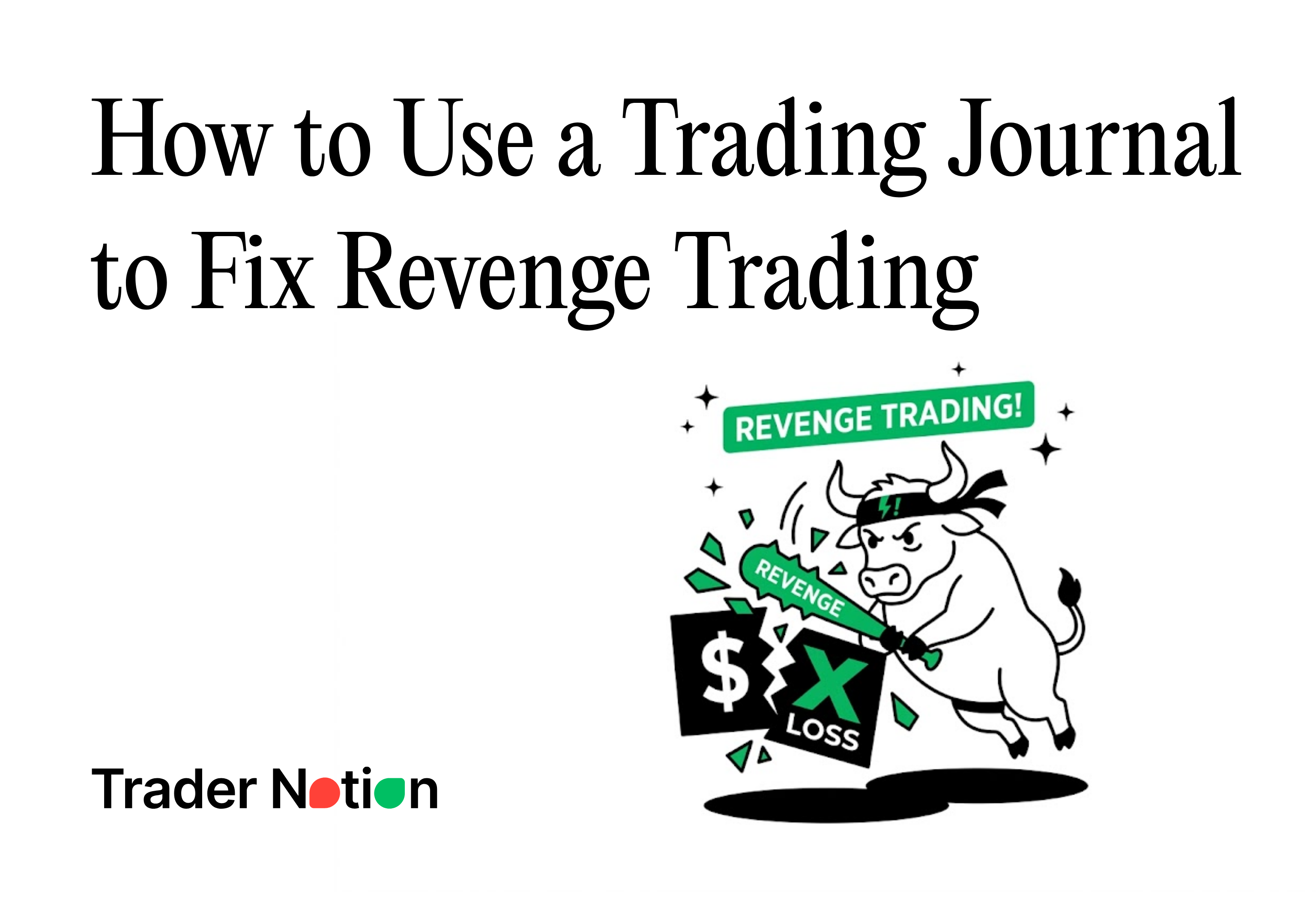
TLDR: Revenge trading — the impulse to immediately jump back into the market after a loss to "win it back" — is one of the fastest ways to blow an account. A trading journal is the most effective tool to break the cycle because it turns emotional reactions into measurable data. By tracking your emotional state alongside every trade, you start to see the specific triggers, times of day, and loss thresholds that push you into revenge mode. This guide covers why revenge trading happens, how a journal exposes the pattern, which journal features actively prevent it (emotion tagging, session limits, daily P&L alerts), common mistakes traders make when trying to fix the behavior, and how to start building a revenge-proof journaling process today.
It's 10:47 AM on a Tuesday. You just got stopped out on a trade you were sure was going to work. The setup was clean, the entry was where you wanted it, and the market reversed two ticks past your stop before running in your original direction. You're staring at the screen, jaw tight, already scanning for the next entry. Not because the next setup is there — it isn't — but because the loss feels wrong and something in your brain demands you fix it immediately.
That impulse is revenge trading. And if you've been in the markets longer than a few months, you've felt it. The anger-driven need to recover a loss right now, to prove the market didn't beat you, to get back to breakeven before the session ends. It doesn't matter whether you trade futures, forex, options, or equities. The emotional mechanics are identical: a loss triggers frustration, frustration overrides your trading plan, and you take a trade you wouldn't take if the previous one hadn't happened.
The problem isn't the emotion itself. Every trader feels it. The problem is that most traders have no system for catching the pattern before it turns into a blown day — or a blown account. A trading journal is that system. Not a spreadsheet where you log tickers and P&L, but a structured process that tracks the emotional context behind your decisions and surfaces the patterns you can't see in real time.
Revenge trading isn't a character flaw. It's a neurological response. When you take a loss, your brain registers it as a threat — the same circuitry that fires when you're in physical danger. Your amygdala hijacks rational thought, dopamine levels drop from the loss, and your brain starts craving the fastest possible route back to feeling in control. Taking another trade feels like the solution, even when every piece of logic says it isn't.
This is why telling yourself "just stop doing it" doesn't work. You're not fighting a bad habit. You're fighting a hardwired stress response that evolved long before financial markets existed. The emotional sequence is predictable: a loss triggers frustration, frustration creates urgency, urgency bypasses your trading plan, and you enter a position based on the need to recover rather than on any valid setup. Position size often increases because the brain is trying to accelerate the recovery — which only amplifies the next loss if the trade fails.
The traders who actually overcome revenge trading don't rely on discipline in the moment. They build systems that interrupt the cycle before emotion takes control. And the most effective of those systems is a trading journal that forces self-awareness at the exact moments when awareness is hardest to maintain.
The core problem with revenge trading is that it feels different every time it happens. One day it's anger after a stop-hunt. Another day it's frustration after missing a runner. A third day it's the quiet, creeping need to "just take one more trade" before the session ends. In real time, each instance feels unique and justified. In a journal, they all look the same.
When you log not just what you traded but how you felt before entering, the data starts revealing patterns within a few weeks. You might see that 80% of your revenge trades happen after two consecutive losses. Or that you always size up in the first 15 minutes after a losing trade. Or that your worst days share a common trigger: a loss during the first 30 minutes of the session that sets an emotional tone you never recover from.
None of these patterns are visible in a standard P&L sheet. They require a journal that captures emotional state, the time gap between trades, whether the trade followed your plan, and the size relative to your normal risk. Once those data points exist across 50–100 trades, the revenge trading pattern stops being invisible. It becomes a line on a chart — a measurable behavior with specific triggers that you can design rules around.
Professional traders treat this data the way an athlete treats film review. The goal isn't to feel bad about mistakes. It's to identify the specific conditions under which mistakes happen so you can build a pre-game plan that accounts for them. A journal that tracks emotional state alongside trade outcomes creates the film you need to review.
Awareness alone isn't enough. The best trading journals include features specifically designed to interrupt the revenge cycle in real time, not just document it after the fact.
Emotion tagging lets you label each trade with your psychological state at the time of entry: calm, anxious, frustrated, FOMO, revenge, overconfident. Over time, this creates a dataset that shows how emotional state correlates with trade quality. Many traders discover that their win rate on trades tagged "frustrated" or "revenge" is dramatically lower than trades tagged "calm" or "planned." Seeing that gap as a hard number — not a vague feeling — changes behavior faster than any motivational advice.
Some journals let you set maximum trade counts or session time limits. If you know from your data that your third trade after a losing streak is almost always a revenge trade, you can set a hard cap: three trades per session, no exceptions. The rule doesn't rely on your willpower in the moment because the system enforces it. Forced cooldown triggers — mandatory 15–30 minute pauses after hitting a loss threshold or a set number of rule breaches — serve the same function. They create a physical break between the emotional trigger and the next trade, giving your prefrontal cortex time to re-engage.
Daily loss limit visibility is critical for traders who revenge-trade their way past their daily max. A journal or dashboard that shows your remaining loss buffer in real time — and alerts you when you're approaching your limit — interrupts the trance state that revenge trading creates. You're no longer guessing whether you've "gone too far." The number is in front of you, updating with every trade. For prop firm traders especially, where a daily loss limit breach can end an evaluation, this feature isn't optional. It's account survival.
A journal that requires you to fill out a checklist before each trade — confirming your setup criteria, emotional state, and plan adherence — adds friction to the revenge trade. Revenge trading thrives on speed: the faster you can click "buy" after a loss, the less time your rational brain has to object. A mandatory three-question checklist ("Does this match my setup? Am I within my daily risk? Is my emotional state neutral?") slows the process just enough to break the impulse loop.
Different trading journals handle revenge-trading prevention with varying levels of depth. Here's how the major platforms compare across the features that matter most for breaking the revenge cycle:
| Feature | TradeZella | TraderSync | Edgewonk | TradesViz |
|---|---|---|---|---|
| Emotion Tagging | Built-in mood tracker | Custom tags | Emotion/tilt tracking (core) | Custom tags |
| Session / Trade Limits | Rule-based alerts | Custom rules | Tilt meter + alerts | Manual rules |
| Daily P&L Dashboard | Auto (real-time) | Auto | Auto | Auto |
| Pre-Trade Checklist | Built-in | Notebook feature | Custom checklist | Custom fields |
| Post-Trade Reflection | Built-in prompts | Notes per trade | Psychology journal | Notes per trade |
| Behavioral Pattern Reports | Performance by emotion | Filterable reports | Emotional leakage reports | Custom analytics |
Edgewonk stands out for traders whose primary problem is psychological. Its "tilt meter" and emotional leakage analysis were designed specifically to quantify how much money a trader loses to emotional decisions versus strategy failures. If your journal data shows that your strategy is profitable but you keep sabotaging it, Edgewonk's psychology-first approach provides the clearest feedback loop.
TradeZella balances ease of use with built-in emotion tracking and pre-trade checklists, making it a strong option for traders who want structured psychology tools without a steep learning curve. TraderSync offers flexible custom tagging and filterable reports that let you build your own revenge-trading analysis — if you're willing to configure it. TradesViz provides the raw analytical horsepower to slice emotional data any way you want, though it requires more manual setup than the others.
Relying on willpower instead of systems. "I'll just stop" is not a plan. The neurological response that drives revenge trading operates below conscious decision-making. You need external guardrails — journal rules, session limits, loss alerts — that enforce discipline when your brain is in fight-or-flight mode. Build the system on calm days so it's already running when the emotional days arrive.
Logging trades without logging emotions. A journal that only tracks tickers, entry prices, and P&L is a record keeper, not a behavior-change tool. If you're not recording your emotional state, you can't see the correlation between frustration and poor outcomes. The emotional data is the entire point. Without it, you're reviewing film with the sound off.
Setting rules but never reviewing them. Creating a "no more than 3 trades after a loss" rule is step one. Step two is reviewing your journal weekly to check whether you followed the rule, what happened when you didn't, and whether the rule needs adjusting. Rules without review become suggestions, and suggestions don't stop revenge trades.
Treating every loss as a trigger to fix. Not every loss should produce an emotional reaction. A trade that followed your plan and hit your stop is a successful execution of your process. A journal that separates "good losses" (plan-adherent trades that didn't work) from "bad losses" (emotional entries, oversized positions, rule breaks) helps you direct your corrective energy at the right problem. Professional traders evaluate whether the loss followed the plan. If it did, the trade is considered a success regardless of outcome. That mindset shift is critical for avoiding the spiral.
Expecting instant results. Journaling changes behavior over weeks and months, not days. The first two weeks feel tedious. The insights that break the revenge pattern usually emerge between weeks three and six, once you have enough data to see repeating triggers. Quitting before that threshold is the most common reason traders say "journaling doesn't work for me."
Step 1: Establish your baseline. For the next two weeks, log every trade with three additional fields: emotional state before entry (calm, frustrated, anxious, revenge, FOMO), whether the trade followed your plan (yes or no), and the time gap since your last trade. Don't try to change anything yet. Just collect the data.
Step 2: Identify your personal triggers. After two weeks, review your journal and look for the pattern. At what loss threshold do you start taking unplanned trades? How quickly after a loss do revenge trades happen? What time of day are they most common? Which emotional tag shows up most often before your worst trades? The answers are in the data — your job is to read them without judgment.
Step 3: Build three rules from the data. Based on what you find, create three specific, enforceable rules. These should be personal to your patterns, but common examples include: "If I hit two consecutive losses, I take a mandatory 15-minute screen break," "No trade within 10 minutes of a loss," or "After reaching 1.5R daily loss, I'm done for the session." Write these rules at the top of your journal where you see them before every session.
Step 4: Set up automated guardrails. Choose a journal that supports real-time loss tracking and emotional tagging — TradeZella, Edgewonk, or TraderSync all work here. Configure daily loss alerts, set up your emotion tags, and enable any session-limit features available. The more your tools enforce the rules, the less you need to rely on in-the-moment discipline.
Step 5: Review weekly and adjust. Every Sunday (or whenever your trading week ends), spend 20 minutes reviewing your journal through one lens: did I follow my rules, and what happened when I didn't? Track your rule-adherence rate as a metric. Over four to six weeks, that number should trend upward — and your revenge-trade losses should trend down. Adjust your rules as new patterns emerge. The journal is a living system, not a set-it-and-forget-it tool.
Revenge trading is the impulse to immediately enter a new trade after a loss, driven by the emotional need to recover money rather than by a valid setup. It's destructive because it compounds losses: the trade is taken without proper analysis, often with increased position size, during a mental state that impairs judgment. One unplanned revenge trade after a normal loss can turn a manageable red day into an account-threatening drawdown. The behavior feeds on itself — each revenge loss increases the emotional pressure to take another trade to recover, creating a spiral that can consume an entire day's or week's gains in a single session.
Most traders begin to see their personal revenge-trading triggers within two to three weeks of consistent emotion-tagged journaling. Meaningful behavior change — where you catch yourself before the revenge trade rather than after — typically takes four to eight weeks. The timeline depends on how many trades you take (more data means faster pattern recognition) and how consistently you review your journal. Daily logging with a weekly review produces results significantly faster than sporadic journaling.
Technically yes, but practically it's much harder. A spreadsheet can log emotional state and trade outcomes, but it won't calculate emotion-correlated performance, alert you when you're approaching your daily loss limit, or surface behavioral patterns automatically. Dedicated journals like Edgewonk and TradeZella reduce the friction between data collection and insight generation, which matters because revenge trading is a problem that requires consistent monitoring. The easier the process, the more likely you are to maintain it long enough for the patterns to become visible.
Overtrading is taking too many trades relative to your plan, often driven by boredom, FOMO, or the belief that more trades equal more profit. Revenge trading is a specific type of overtrading triggered by a prior loss — the motivation is emotional recovery, not opportunity. All revenge trading is overtrading, but not all overtrading is revenge trading. The distinction matters because the journal data that identifies each pattern is different: overtrading shows up as high trade counts on days with no unusual losses, while revenge trading shows up as clustered trades immediately following a loss, often with larger position sizes.
Yes. The emotional response to loss is neurological, not a skill issue — experienced traders feel the same impulse. The difference is that professional traders build systems to manage it: mandatory cooldown periods after losses, hard daily loss limits enforced by their firm or their own rules, and structured journaling that separates "good losses" (plan-adherent trades that didn't work out) from "bad losses" (emotional, unplanned entries). They've learned through data — usually from their own journals — exactly where their psychological breaking points are, and they design their trading day to avoid reaching those points.
Related Articles:
Join our newsletter to get the latest updates on new tools, features and products we're adding.










.jpeg)